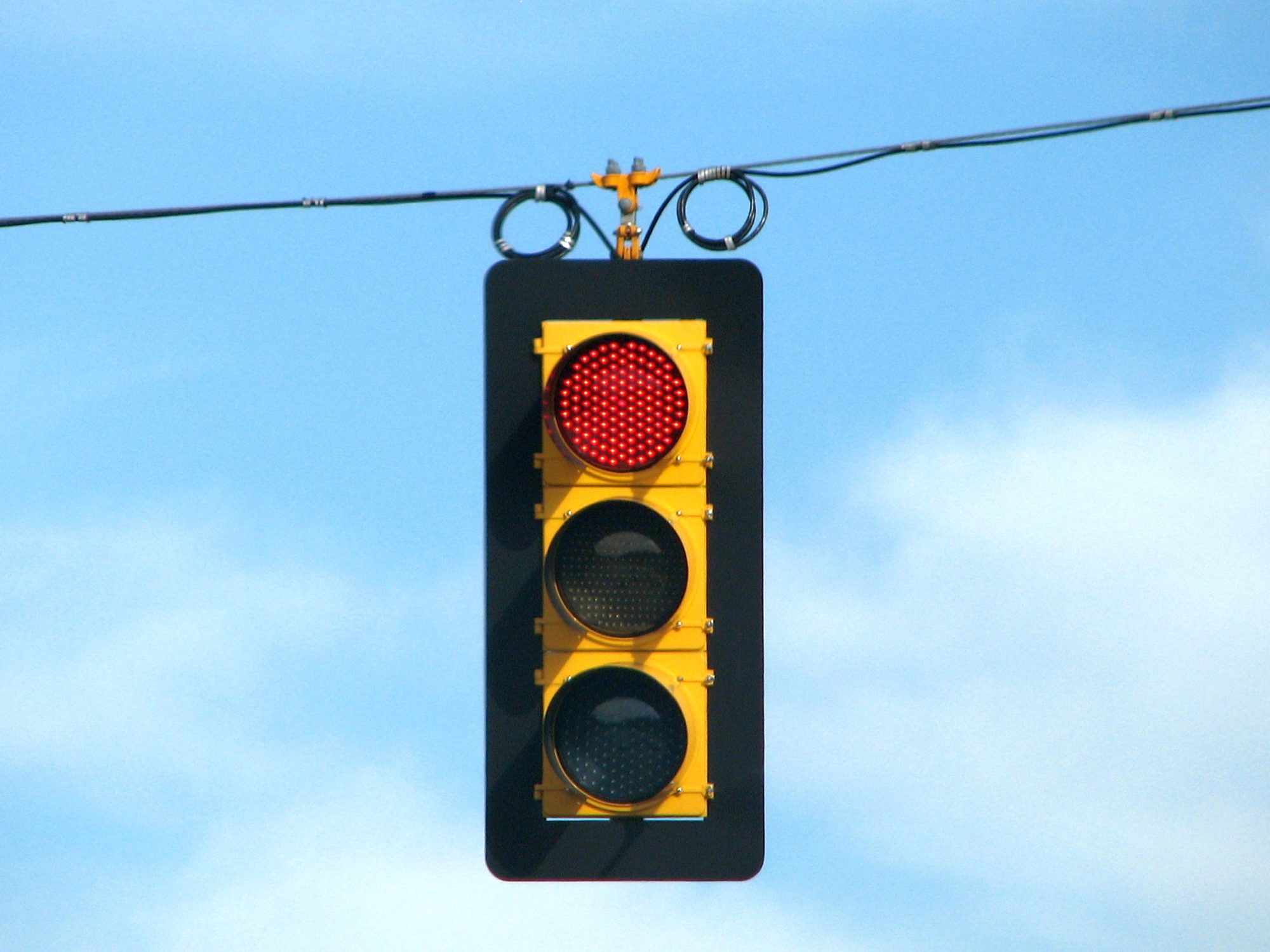
The Encinitas City Council discussed bringing back red-light cameras at its Wednesday, Sept. 9 meeting. The debate came more than a year after 12-year-old Emery Chalekian was killed crossing Encinitas Boulevard.
City Traffic Engineer Abe Bandegan presented a staff report to Mayor Bruce Ehlers and the four-member council recommending a limited pilot program under Senate Bill 720, the state law signed by the governor in October 2025 that created a new framework for automated red-light enforcement. The report outlined a process starting with an Automated Traffic Enforcement System Impact Report, followed by public review, a public hearing and vendor selection.
Bandegan's report said pilot locations would be chosen based on traffic-safety need rather than anticipated citation volume or revenue.
The council is scheduled to revisit the topic Wednesday, Sept. 16, when it will consider a formal letter from the Mobility and Traffic Safety Commission recommending the city review and adopt a red-light camera policy, according to the Sept. 16 agenda.
How SB 720 changes the rules
Encinitas ran red-light cameras for about 16 years under a contract with Redflex, with cameras at Encinitas Boulevard and El Camino Real and at Leucadia Boulevard and El Camino Real. That contract expired in May 2020.
The old program treated violations as traffic citations carrying roughly $490 in fines and court fees. SB 720, which took effect Jan. 1, treats violations as civil penalties instead. A first offense carries a $100 fine with no license points and no driver's license suspension. Repeat violations within three years escalate to $200, $350 and $500. The law requires an 80-percent fine reduction for indigent persons and a 50-percent reduction for qualifying lower-income residents.
Cameras under SB 720 photograph the rear license plate rather than the driver. Facial-recognition technology is prohibited.
Safety data and opposition
A 2018 city staff report found the former cameras reduced collisions at both intersections. At one location, red-light-related crashes dropped from an average of 2.0 per year before installation to 0.32 per year after. At the other, they fell from 1.9 to 1.2 per year.
A Vision Zero Coalition letter submitted Sept. 4 and signed by Circulate Planning & Policy, San Diego County Bike Coalition, Families for Safe Streets San Diego and AARP California urged the council to support the program. The coalition cited data showing New York City intersections with red-light cameras saw a 73-percent decrease in red-light running.
Commissioner Ron Medak submitted written opposition, arguing that crash data he reviewed from the California Crash Reporting System showed more collisions at camera intersections than at control intersections during the period he examined.
How the push started
The push for cameras gained momentum after Emery Chalekian was struck and killed April 25, 2025, while crossing Encinitas Boulevard at Village Square Drive. The driver, 44-year-old Eddie Segendo, is alleged to have run the red light, according to the San Diego Union-Tribune.
"Prevent the next family from standing where I stand today," Bridget Chalekian, Emery's mother, told the MTSC in February when the commission first took up the issue.
The MTSC voted 5-1 on Feb. 9 to recommend the council consider red-light cameras, with Medak the lone dissenter. The commission transmitted that recommendation March 9. Safe Streets Encinitas, a group that formed after Emery's death, has advocated for the cameras throughout the process.
The next regular council meeting is Wednesday, Sept. 16. The Sept. 16 agenda lists the MTSC's red-light camera recommendation as Item 12B.