Carolina Saucedo Cervantes completed a yearlong fellowship at the San Diego Botanic Garden studying a native shrub at risk of poaching. Her target: California Yerba Santa, an evergreen plant now drawing attention in Alzheimer's research.
Cervantes, a Rare Plant RaMP specialist at the Encinitas garden, wrapped up the one-year postbaccalaureate research program focused on the chemistry of California Yerba Santa (Eriodictyon californicum), a shrub found only in the California Floristic Province. The plant has long been used in traditional medicine and is gaining interest in neurodegenerative disease studies, according to a garden profile published Tuesday, Sept. 1.
That growing interest worries conservationists.
"Public interest in this species may increase due to its study in neurodegenerative and Alzheimer's research as well as traditional uses," Cervantes wrote in the profile. "This could lead to a conservation concern due to increased poaching of wild populations, an issue that we saw with the last decade's crisis of white sage."
Cervantes wrote that metabolomics studies can help inform responsible harvesting by pinpointing where and when specific chemical compounds appear in the plant. That data could promote sustainable commercial growing and reduce pressure on wild populations.
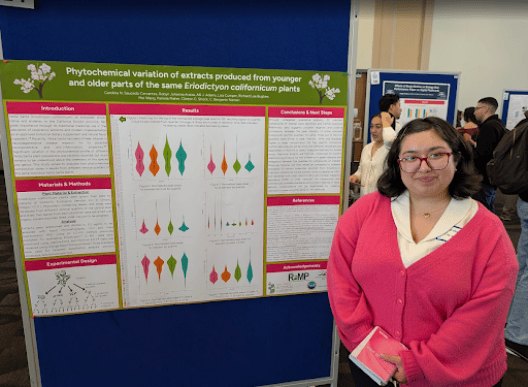
Her lab work used liquid chromatography mass spectrometry to identify and measure key phytochemicals in the shrub. She compared concentrations in old versus new growth and examined differences between common and rare genotypes of the species.
The research also has a consumer-protection angle. Yerba Santa is sold as a dietary supplement and natural flavor ingredient. Cervantes wrote that identifying its metabolites can help create a standardized method for confirming that products labeled as yerba santa actually contain the species.
Cervantes graduated from the University of California, Santa Cruz in June 2025 with a B.A. in chemistry and a B.S. in plant science. She wrote that she applied to the fellowship hoping to learn how chemistry can inform plant conservation.
The Rare Plant RaMP program, short for Research and Mentoring for Postbaccalaureates in Biological Sciences, is funded by the National Science Foundation. San Diego Botanic Garden is one of four gardens nationwide in the network, alongside Atlanta Botanical Garden, California Botanic Garden and The Morton Arboretum, according to the program's description.
The garden's broader medicinal plants research program, launched in early 2022 with funding from The Conrad Prebys Foundation, has grown its living collection to more than 2,300 taxa from fewer than 500 three years prior, according to a March 2025 garden post. C. Benjamin Naman, the garden's director of medicinal plants research, identified yerba santa as "particularly important and impactful" among the native medicinal plants under study.
During her fellowship, Cervantes presented her findings at the garden's Science Seminar Series, at SuperSTEM Saturday at California State University, San Marcos, at tribal Earth Day events and at the Cohen Military Family Clinic STEM night.
The garden's yerba santa research is conducted in partnership with the Salk Institute for Biological Studies and Cal State San Marcos, according to a 2024 symposium report. The garden is located at 300 Quail Gardens Drive in Encinitas.