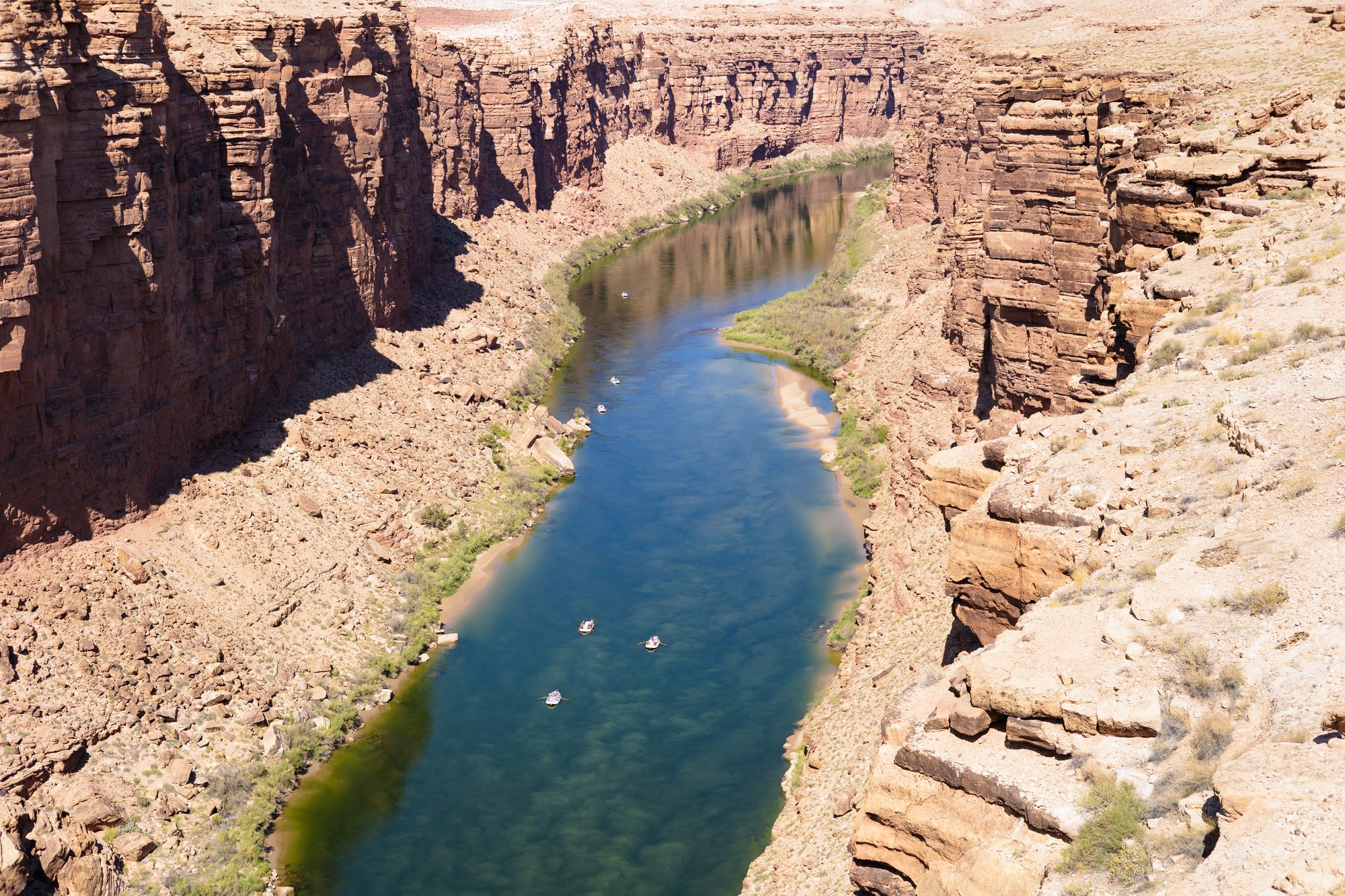
Encinitas faces minimal disruption from steep federal Colorado River water cuts because the region's supply portfolio no longer depends heavily on the river.
The U.S. Department of the Interior finalized the reductions Friday, Aug. 21, requiring California, Arizona and Nevada to cut combined Colorado River usage by 1.25 million acre-feet annually in 2027 and 2028. California absorbs the second-largest share at 440,000 acre-feet per year. Arizona faces 760,000 acre-feet; Nevada, 50,000.
The San Diego region, which supplies Encinitas through the San Dieguito Water District and the Olivenhain Municipal Water District, is better insulated than most of the state, KPBS reported Wednesday. Three investments form the buffer: the Claude "Bud" Lewis Carlsbad Desalination Plant, large-scale water recycling projects and a 2003 conservation agreement called the Quantification Settlement Agreement (QSA).
The Carlsbad plant, the nation's largest seawater desalination facility, sits just north of Encinitas near Carlsbad State Beach. It produces about 50 million gallons of drinking water daily through reverse osmosis, supplying 7% to 10% of the region's water, according to NPR. The plant came online in late 2015 at the site of a former coal-fired power plant.
The QSA gives the San Diego County Water Authority (SDCWA) senior-priority access to nearly 280,000 acre-feet of conserved Colorado River water annually, derived from agricultural conservation in the Imperial Valley.
Jim Madaffer, an SDCWA board member and vice chair of the Colorado River Board of California, told KPBS the region's portfolio provides strong protection.
"I think we're in fairly good shape no matter what the federal government ends up doing," Madaffer said.
Felicia Marcus, former chair of the California State Water Resources Control Board and a visiting fellow at Stanford University's Water in the West program, told KPBS that San Diego "is actually one of the more efficient urban areas in the entire state, probably trailing only San Francisco and Santa Cruz as major cities."
The supply surplus has grown large enough that the SDCWA signed a deal in March 2026 to sell water to a Riverside County agency, generating $13.5 million annually. The authority is also exploring sales to Nevada and Arizona, a transaction never done across state lines. The Southern Nevada Water Authority and the Central Arizona Project signed a memorandum of understanding in June 2026 to explore buying San Diego's water.
Desalinated water costs five to ten times more than river water, according to NPR's reporting. But Marcus argued the investment pays for itself. "The cost is a pittance compared to the cost of inaction when the taps run dry," she told KPBS.
Nevada filed a federal lawsuit Monday, Aug. 24, challenging the cuts. The plan could leave southern Nevada with less than 86,500 acre-feet per year, far below the roughly 212,500 acre-feet Las Vegas used in 2024, according to the Leaf-Chronicle.
The current Colorado River operating rules expire at the beginning of October. The new guidelines represent the first two years of a 10-year strategy, with cuts potentially nearly doubling after 2028 if reservoir levels keep falling. Lake Powell and Lake Mead both hit record lows in August 2026.
The San Dieguito Water District's next regular board meeting is Wednesday, Sept. 16. No agenda item on the Colorado River cuts has been confirmed for that meeting.